How PFAS Destruction Works: The Full Process, Start to Finish
Watch our new video below, then read on for more.
Where Did “Forever Chemicals” Come From?
PFAS, or per- and polyfluoroalkyl substances, commonly referred to as “forever chemicals,” were first developed in 1938, when a chemist working on refrigerants discovered polytetrafluoroethylene by accident. Once produced, it was apparent that this material could be extremely helpful across a range of industries, so it was commonly used for things like nonstick cookware, stain-resistant fabric and carpet, water repellents, food packaging, and firefighting foam.
As Taylor Cochran, Revive’s Lead Process Engineer, mentions in the video, it was made to be an inert chemical, and it does a great job at not reacting with other things that it comes in contact with. That is what makes it really great for putting out fires and repelling water.
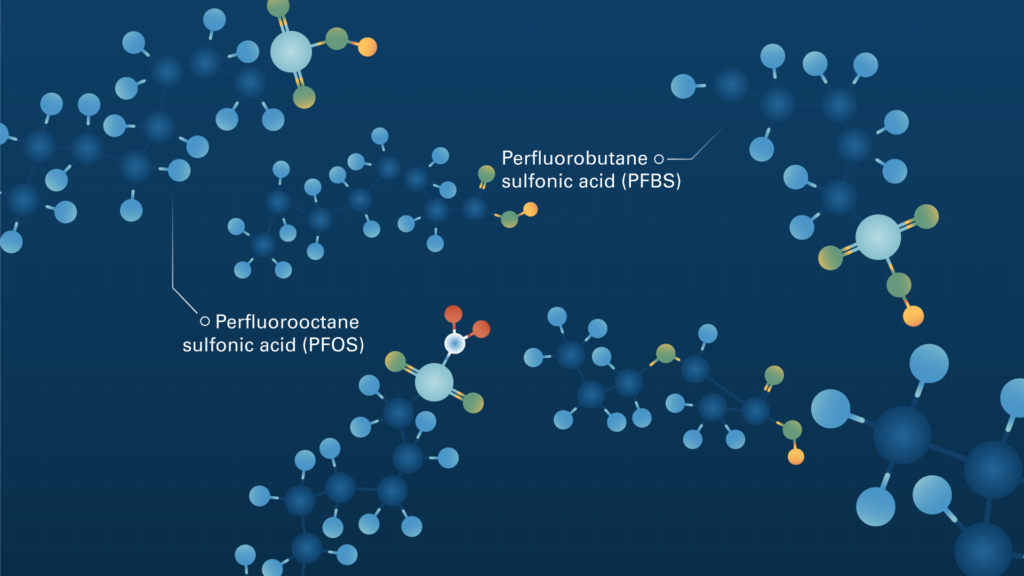
Over time, PFAS was found to be toxic at very low levels. In 2023 the International Agency for Research on Cancer classified PFOA as carcinogenic to humans and PFOS as possibly carcinogenic. Because of how widely these chemicals were used, PFAS has also been found extensively throughout the environment and in the human body.
“PFAS is one of the toughest environmental contaminants we’ve ever dealt with. It’s persistent, it accumulates in the human body, and most importantly, it’s toxic at really low levels.
– Rick Gillespie, CEO
What made it so good at what it was designed for also made it difficult to remove from the environment. It was adopted widely for use in firefighting foams on hydrocarbon (fuel-based) fires. The U.S. Navy and 3M patented the first aqueous film-forming foam, or AFFF, in 1966, and it was used extensively throughout the world for decades. Regulations are catching up, and the use of AFFF, along with PFAS as a whole, is being phased out.
The carbon-fluorine bond within the suite of PFAS molecules is one of the strongest in organic chemistry and breaking that bond is the key to getting rid of the problem it causes. Historically that has been very difficult, requiring enough energy and money to be cost prohibitive. There was also a lack of technologies available that could do it reliably and consistently. In April 2024 the EPA set the first federal drinking water limits for PFOA and PFOS at 4 parts per trillion, a threshold that low because of how toxic PFAS is at very low concentrations.
What PFAS Waste Streams Can Be Destroyed?
PFAS is found in a number of different waste streams including biosolids, soils, spent filtration media, and aqueous streams.
At Revive, we focus on aqueous or liquid streams of PFAS. Currently, our facility is full of AFFF, collected from state level collection and destruction programs, spearheaded by Ohio, New Hampshire, North Carolina, and New Jersey. If you look through our facility and the material in staging for destruction, you’ll find mostly AFFF, but you’ll also find the rinsewater from airport foam transition programs and from rinsing AFFF containers, and concentrated forms of other aqueous phases like landfill leachate, industrial wastewater, and contaminated groundwater.
“We help everyone from state takeback programs dealing with the challenges of AFFF, to landfills dealing with high-volume recurring streams, commercial airports working through foam transition, the petrochemical industry, and contaminated groundwater.”
– Rick Gillespie, CEO
The graphic below shows the waste streams that Revive accepts for PFAS processing and destruction.
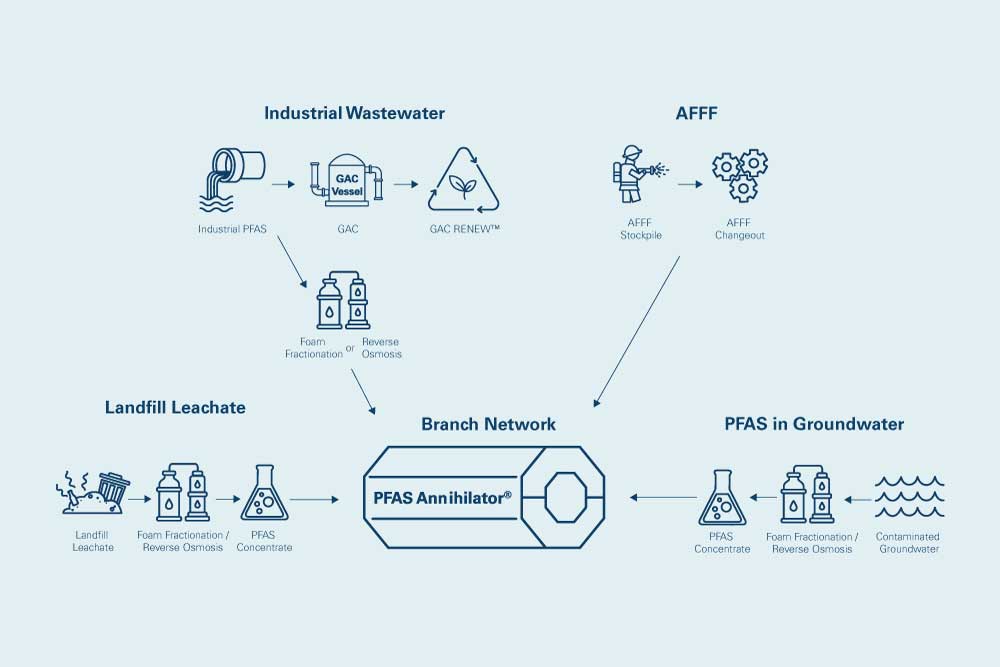
Revive covers a wide range of waste types, including:
What Is Supercritical Water Oxidation and How Does It Work?
Revive collects these streams of aqueous material, then we feed them directly into our PFAS Annihilator® system, which relies on supercritical water oxidation (SCWO). When water enters the supercritical state, it exhibits the properties of both liquid and gas. To get to that supercritical state, we use high temperatures exceeding 705°F (374°C) and a high pressure of 3,210 psi. Once we get there, the carbon-fluorine bonds break, and the PFAS is destroyed. The result is greater than 99.99% destruction and removal efficiency (DRE), verified by independent third-party laboratory testing.
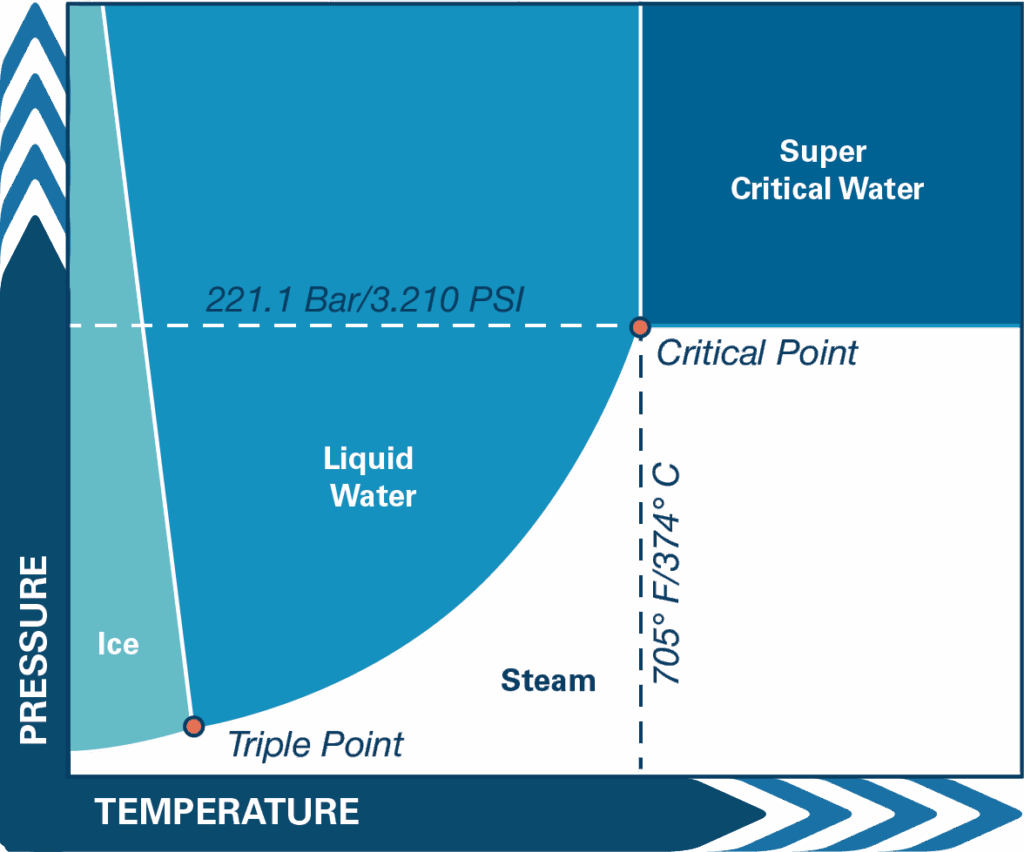
Destruction is different from removal. Filtration and other removal technologies separate PFAS from water and concentrate it, but the PFAS still exists and still carries liability. SCWO breaks the carbon-fluorine bond, so the compound no longer exists.
Documentation That Closes the File
At our Columbus facility, once the treated effluent is tested, it can be safely discharged. We help customers manage their waste, like AFFF, but we provide services well beyond verified destruction.
“Let’s say you’re a commercial airport with an ARFF vehicle that’s got AFFF in it. Revive would come help you clean out that truck, barcode the material at the site, and ship it responsibly to one of our permitted facilities.”
– Rick Gillespie, CEO
From there we process that material through storage and handling, treat it via SCWO, and send samples off for confirmation analytical results. Once those results come back, we discharge the treated effluent through a publicly owned treatment works, or publicly owned treatment works (POTW).
We provide customers peace of mind that their material is being handled properly. We provide full chain of custody insights, so we can tell you when the material was collected, staged for destruction, and processed via SCWO, then tested by an independent laboratory using EPA Method 1633 against permitted discharge levels prior to release. The customer receives a Certificate of Processing, which ends their liability associated with their PFAS impacted materials.
Ohio’s AFFF Takeback Program
We know the dangers of PFAS, and how persistent it is in the human body and the environment. The work that we do matters on a local level as well as a national one. One of our greatest success stories comes from our statewide AFFF collection and destruction programs.
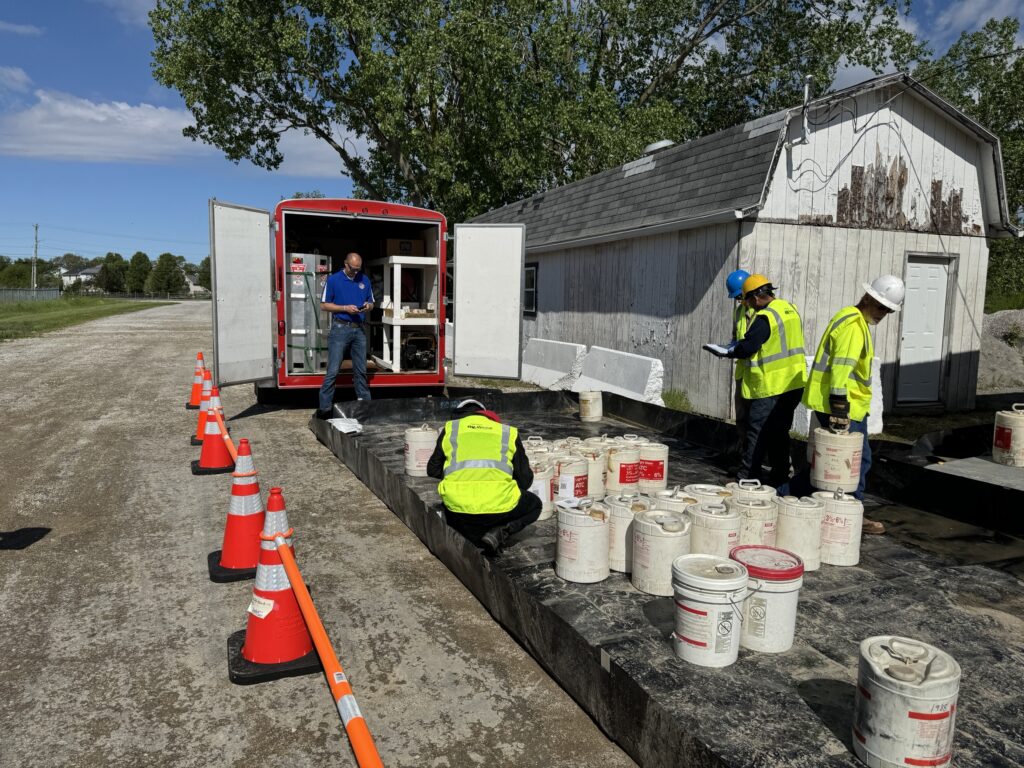
“We took back AFFF from all counties in Ohio, including the township I grew up in. I was really excited to see Ashtabula County Fire Department on a bucket of AFFF, because I know they were able to remove the PFAS out of their backyard, where I grew up right on Lake Erie.”
– Taylor Cochran, Lead Process Engineer
Rick has seen the same impact firsthand at the collection events themselves.
“Families come and say thank you, because you’re taking these firefighting foams out of their local fire departments that their brothers, their husbands, their wives have been exposed to.”
– Rick Gillespie, CEO
The PFAS problem persisted for so long because there was nowhere for the material to actually go. Revive changed that. The technology is permitted, commercially operating, and destroying PFAS today.
If you are sitting on a stockpile of AFFF, or you are a landfill operator figuring out how to manage your leachate without impacting operations, the playbook exists.
Revive can scope the volume, the timeline, and the documentation your compliance program needs. Contact us to start the conversation and see how we can help solve your PFAS problem.
We’re Hiring
Revive Environmental is looking for skilled engineers, process operators and leaders that want to solve the world’s greatest challenges. Interested in joining the team?