Landfill Leachate Treatment: A Verified Concentration and Destruction Pathway for PFAS
Per- and polyfluoroalkyl substances (PFAS) are considered emerging contaminants, even though two of the most widely used, PFOA and PFOS, are now designated as hazardous substances under the Comprehensive Environmental Response, Compensation, and Liability Act (CERCLA). Found in landfills worldwide, these chemicals have been used since the 1950s for things like waterproofing and stain resistance. Because of their widespread use, PFAS inevitably end up in landfills, where they slowly separate from products as those products degrade. Over time, some PFAS migrate into the liquid that collects within the landfill. That liquid is known as leachate.
Why PFAS in Landfill Leachate Is a Growing Problem
Beyond PFAS impacts, leachate is a problem every landfill must manage. Over 2,000 active landfills in the United States generate more than 15 billion gallons annually. Leachate carries ammonia, heavy metals, and high organic loads that must be treated before discharge. Managing it takes dedicated infrastructure: liners, collection pipes, pumps, storage tanks or lagoons, and either on-site treatment or tanker trucks hauling to a treatment plant.
PFAS adds a new layer on top of that work. It is also a problem for publicly owned treatment works (POTWs), which have typically been the end of the line for leachate. Because conventional methods struggle to treat PFAS, POTWs increasingly reject leachate over PFAS concerns, which in turn pushes landfill operators toward on-site treatment.
Leachate Treatment Options Concentrate PFAS but Don’t Destroy It
Standard PFAS treatment options include carbon filtration, foam fractionation, reverse osmosis, and other technologies. These technologies can be effective at separating and concentrating PFAS, but they typically create a PFAS-rich residual that still requires management.
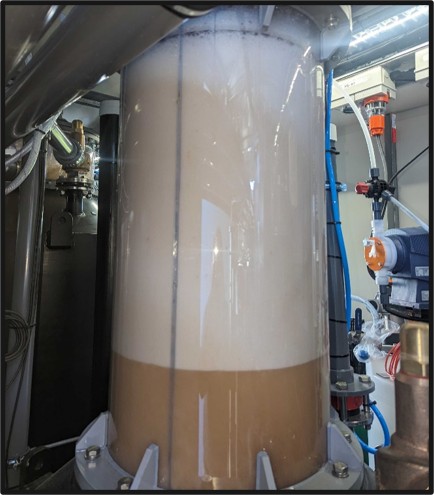
Foam fractionation is a common, energy-efficient, and cost-effective way to concentrate PFAS in leachate. It can concentrate PFAS in leachate by a factor of thousands, depending on the leachate, which shrinks the volume that has to be hauled off site and destroyed. Concentration is a great first step in solving the PFAS problem in landfill leachate, but to end the cycle for good, PFAS must be destroyed.
How Supercritical Water Oxidation Destroys PFAS
Revive Environmental has been operating commercially since 2023 and has experience destroying PFAS in aqueous film-forming foam (AFFF), industrial wastewater, groundwater, and landfill leachate. The technology behind that destruction is supercritical water oxidation (SCWO).
SCWO pushes water past its critical point, 3,200 psi and 374 degrees Celsius. At that pressure and temperature, gas and liquid phases become indistinguishable. Water stops behaving as a polar solvent, and oxygen, which barely dissolves in ordinary water, becomes fully soluble in it. Organic compounds, like PFAS, also dissolve readily in supercritical water, so the PFAS and oxygen end up mixed together in one fluid, where the oxidation reaction can reach the molecules more quickly and completely.
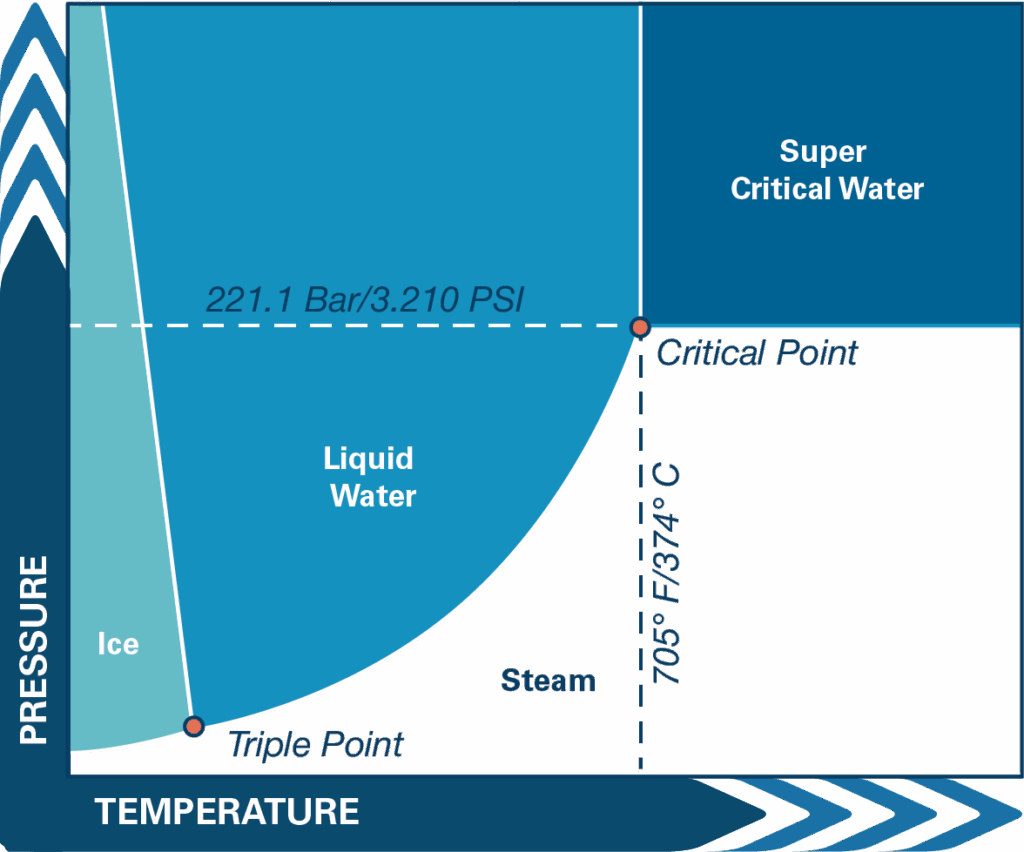
The strength of the carbon-fluorine bond is one reason PFAS persists through conventional treatment. Under supercritical conditions and in the presence of an oxidant, those bonds break and the compounds come apart.
The Four Stages of PFAS Treatment for Landfill Leachate
Treating landfill leachate for PFAS runs through four stages:
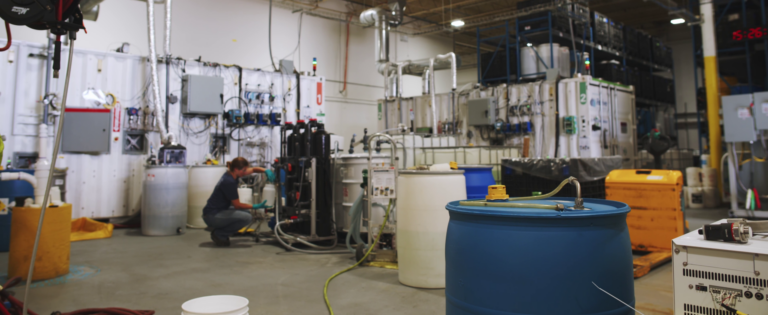
Onsite, a foam fractionation unit concentrates PFAS out of the raw leachate into a hyperconcentrate, cutting the volume that has to leave the site by a wide margin. That concentrate gets transported to a permitted destruction facility, where the PFAS Annihilator® runs it through supercritical water oxidation. Once destruction is complete, an independent lab tests the treated effluent using EPA Method 1633, and Revive issues a Certificate of Processing documenting the result against the discharge limits in the applicable permit.
Two discharge points happen along the way, both under permit. The first comes after concentration, when the bulk of the now PFAS-reduced water goes to the local publicly owned treatment works. The second comes after destruction, when the final treated volume follows the same path.
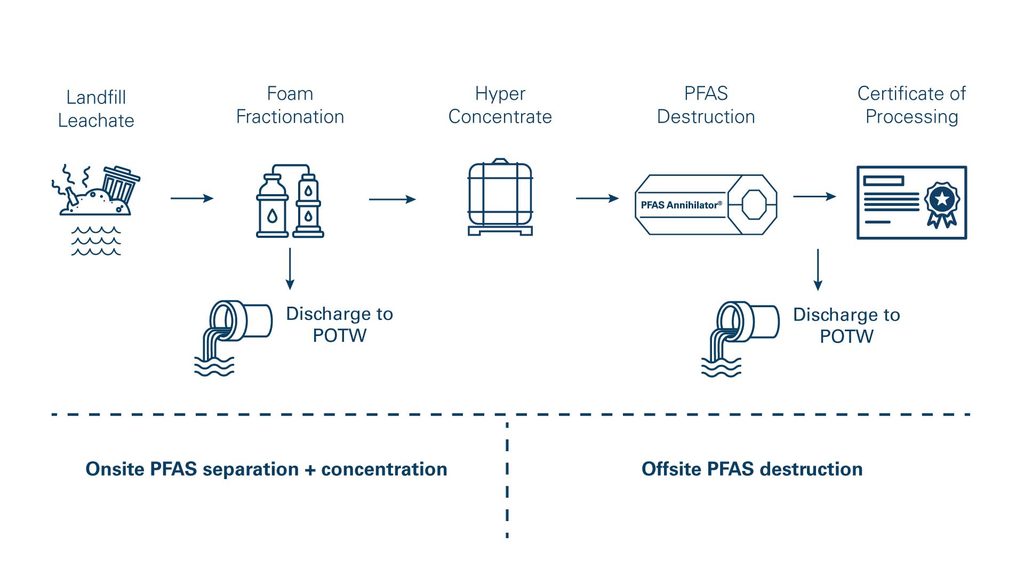
Revive manages separation, transport, destruction, and certification under one contract. That gives landfill operators a single chain of custody from the original leachate through final treatment documentation.
PFAS Destruction Results in Landfill Leachate
For a landfill operator, PFAS in leachate is a waste problem first and a compliance problem second. The waste has to go somewhere, and wherever it goes has to be documented. Here is how one landfill leachate project handled both. A private landfill’s raw leachate went through onsite foam fractionation first. About 1.1 million gallons came out the other end as 14.4 gallons of hyperconcentrate, a volume reduction of more than 70,000 times, with the longer-chain PFAS concentrated into it. That concentrated waste then went through the PFAS Annihilator, which destroyed it, and an independent lab tested the treated water. The table follows eight selected compounds, out of the 21 detected in the hyperconcentrate, through each step.
| Compound | Raw Leachate (ng/L) Before FF Treatment | Foam-Fractionation Hyperconcentrate (ng/L) Before disposal/destruction | Clean Effluent After SCWO (ng/L) After PFAS Annihilator processing |
|---|---|---|---|
| PFOA | 1,394 | 7,180,000 | 0.277^ |
| PFOS | 956 | 3,380,000 | 0.232 ^ |
| PFHpA | 370 | 716,000 | < 0.158 |
| PFHxS | 99 | 432,000 | < 0.266 |
| PFNA | 49 | 234,000 | < 0.228 |
| PFHxA | 582 | 44,600 | < 0.376 |
| PFPeA | 753 | 1,500 | < 0.514 |
| PFBS | 21 | 301 | < 0.161 |
Here is the compliance picture for the compounds in the table. The treated water was tested by an independent lab using EPA Method 1633. Six of the eight were not detected. PFOA and PFOS were detected only at trace, estimated levels below the limit of quantification, at 0.277 and 0.232 ng/L. For comparison, EPA’s drinking water limit is 4 ng/L for each, and this site’s discharge limits are 20 ng/L for PFOA and 8 ng/L for PFOS.
PFOS shows the whole path. The raw leachate carried 956 ng/L. The hyperconcentrate carried 3,380,000 ng/L. After destruction, the effluent measured an estimated 0.232 ng/L, a reduction of more than 99.9999 percent across the destruction step.
The same approach has worked at a much larger scale. In Michigan, three commercial landfills generated more than 160,000 gallons of PFAS-laden leachate a day, and conventional treatment could not meet the state’s discharge limits. Foam fractionation concentrated the PFAS and cut the volume by up to 10,000 times, and the concentrate then went through the PFAS Annihilator. After destruction, PFOA measured 3.8 ng/L and PFOS was not detected, both below EPA’s drinking water standard of 4 ng/L for each. The treated effluent was discharged to a publicly owned treatment works under an NPDES permit.
Why Verified Destruction Matters for CERCLA Exposure
Landfill operators facing CERCLA exposure need to be able to show where the PFAS went. Revive issues a Certificate of Processing at the end of each project. It is a record showing that an independent lab tested the treated effluent using EPA Method 1633 and confirmed it against the discharge limits in the applicable permit.
If your landfill is generating PFAS-impacted leachate and you want to see what a complete concentration-to-certificate program looks like, download our service overview below:
Landfill Leachate PFAS Treatment FAQ
How is landfill leachate different from AFFF or industrial wastewater when it comes to PFAS treatment?
The PFAS Annihilator destroys PFAS the same way regardless of the source. What changes is the front end. Leachate usually needs foam fractionation to concentrate a large, dilute volume before destruction, while AFFF concentrate often arrives already concentrated enough to go straight to the reactor.
Does destroying PFAS from landfill leachate actually reduce a landfill operator’s CERCLA exposure, or just the discharge violation risk?
Destruction can help reduce the amount of PFAS that remains in residual waste streams requiring future management or disposal. For landfill operators evaluating potential CERCLA implications, documented destruction and chain-of-custody records may also provide useful evidence of how PFAS-containing material was managed. Operators should evaluate site-specific liability questions with environmental counsel.
What happens to the concentrated PFAS after foam fractionation? Where does it go, and who is responsible for it?
The hyperconcentrate gets transported to a permitted destruction facility under Revive’s chain of custody. Revive handles that transport and the destruction that follows, so the landfill operator isn’t the one managing a truck full of PFAS-rich material or tracking where it ends up.